> For the complete documentation index, see [llms.txt](https://docs.jakarto.com/guide-tiles/llms.txt). Markdown versions of documentation pages are available by appending `.md` to page URLs; this page is available as [Markdown](https://docs.jakarto.com/guide-tiles/fr/integrer-tiles-dans-arcgis-pro.md).

# Charger les tuiles matricielles dans Arcgis Pro

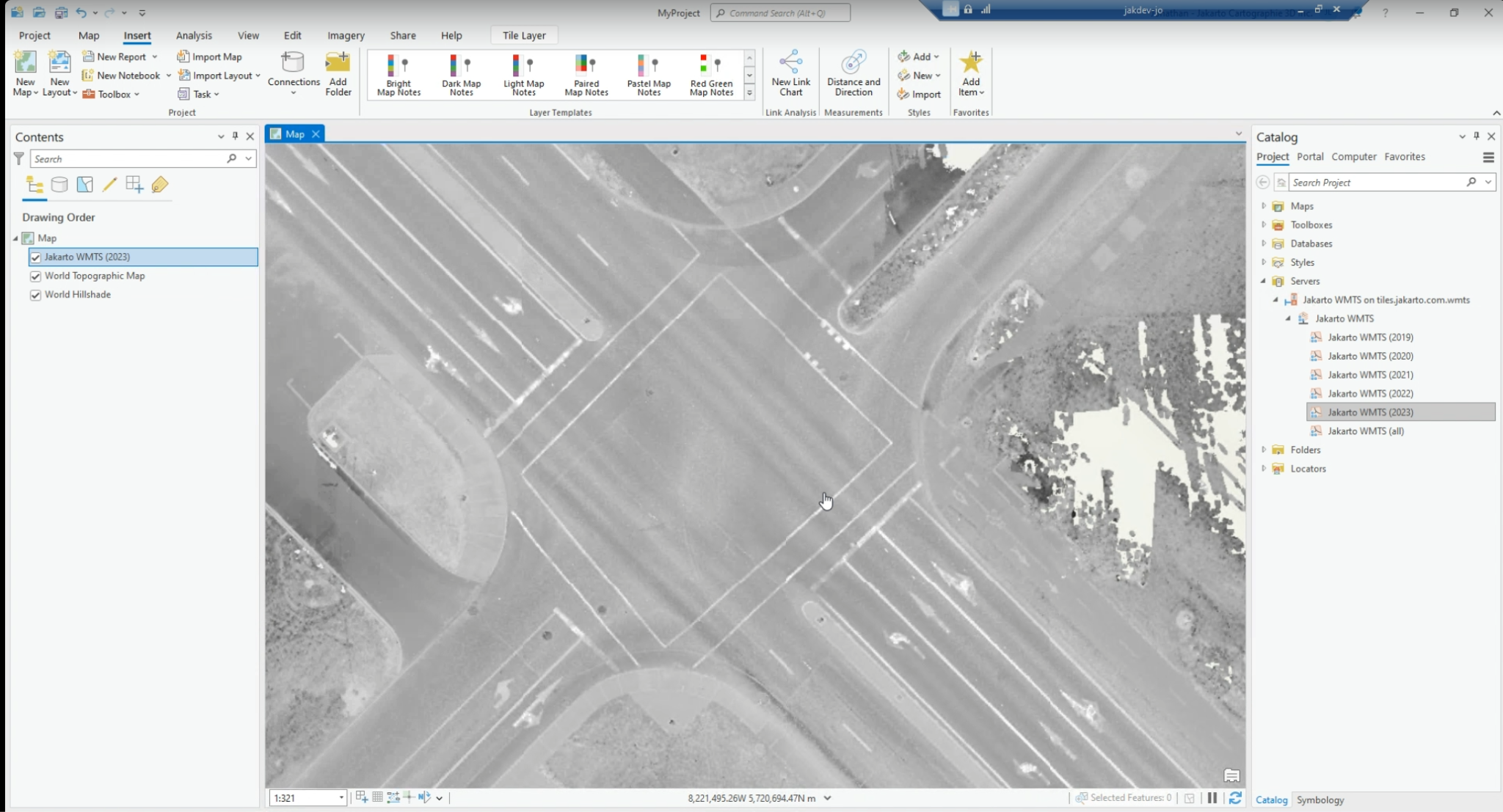
<figure><img src="/files/PQQrLCafKrT3URWadII3" alt=""><figcaption><p>Objectif : Tuiles matricielles dans Arcgis Pro</p></figcaption></figure>

Ce tutoriel a été réalisé à partir du logiciel ArcGIS Pro.

## Etapes à suivre:

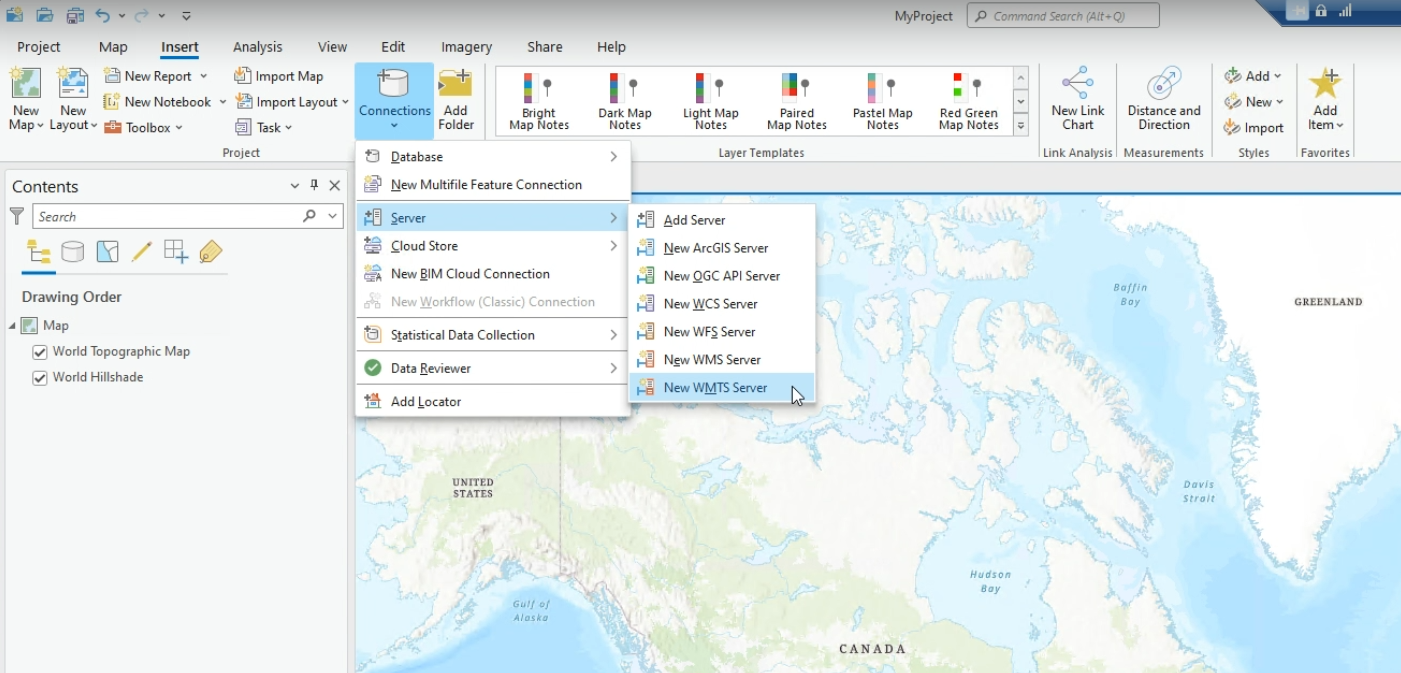
1. Allez dans "Connections" et ajoutez un "Nouveau server WMTS"

<figure><img src="/files/XlAVNBboROUtB4kbxB2s" alt=""><figcaption><p>Nouvelle connexion WMTS</p></figcaption></figure>

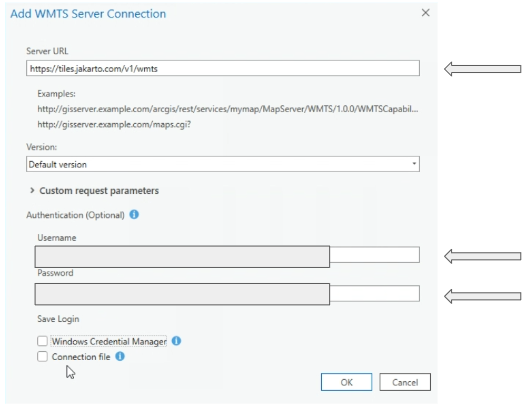
2. Entrez l'URL du serveur de tuiles matriciels tel que décrit ci-contre : <https://tiles.jakarto.com/v1/wmts> Utilisez vos informations de connexion à la plateforme.

<figure><img src="/files/itwaUdIPdfHrNuG0Xm2b" alt=""><figcaption><p>Connexion à un serveur WMTS sur Arcgis Pro</p></figcaption></figure>

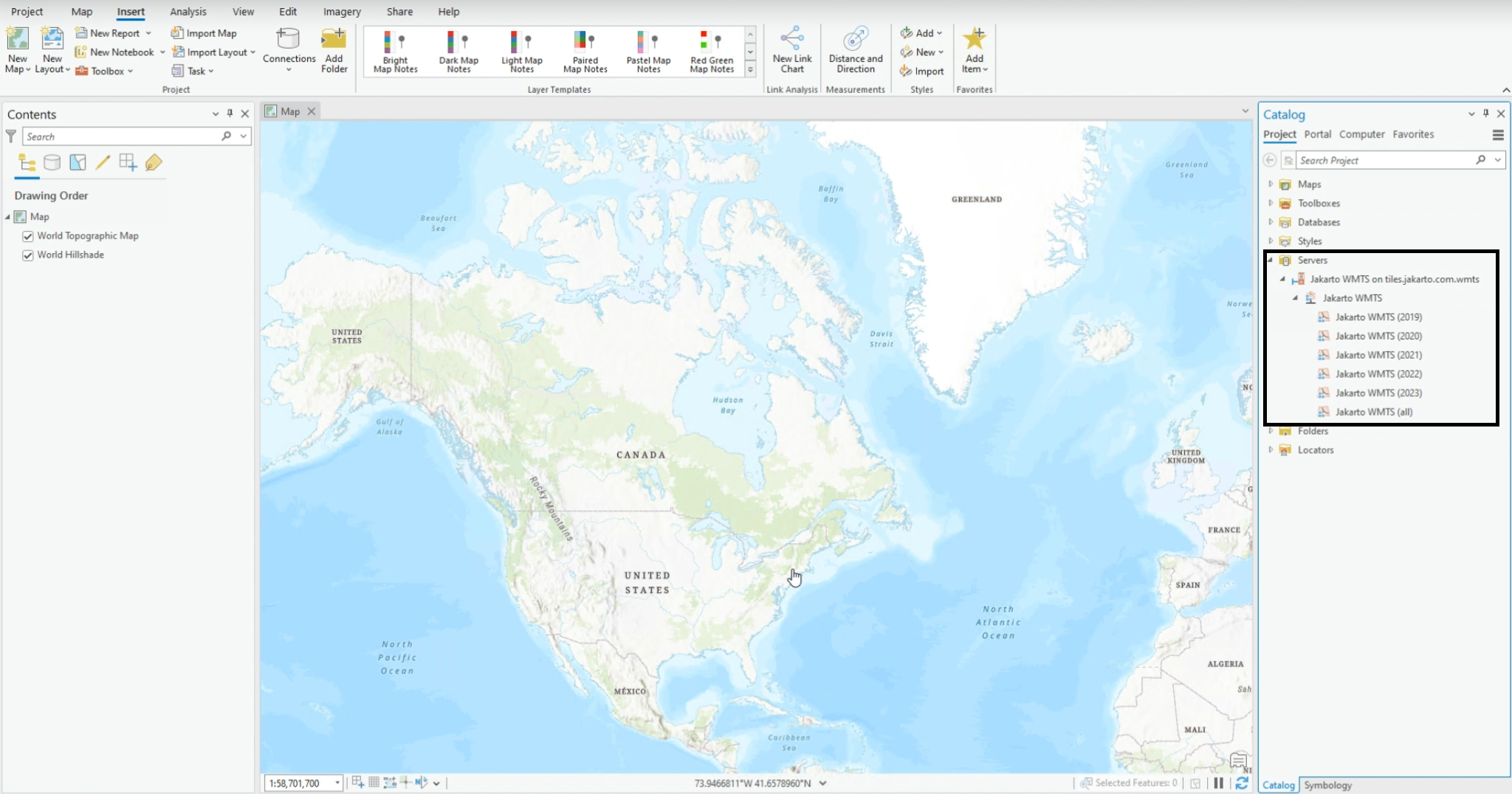
3. Vous avez maintenant accès aux tuiles matricielles à partir de votre fenêtre Catalog de ArcGIS Pro

<figure><img src="/files/UaSbsfz9tYU1zv1QxEJG" alt=""><figcaption><p>Les tuiles matricielles sont disponibles dans le Catalogue</p></figcaption></figure>

Si le volet Catalogue est manquant à l'écran, veuillez ajouter les tuiles matricielles de Jakarto à partir du menu View > Catalogue View > Servers > Jakarto WMTS.

4. Sélectionnez l'année correspondante au passage qui vous intéresse et ajoutez cette couche à votre carte.
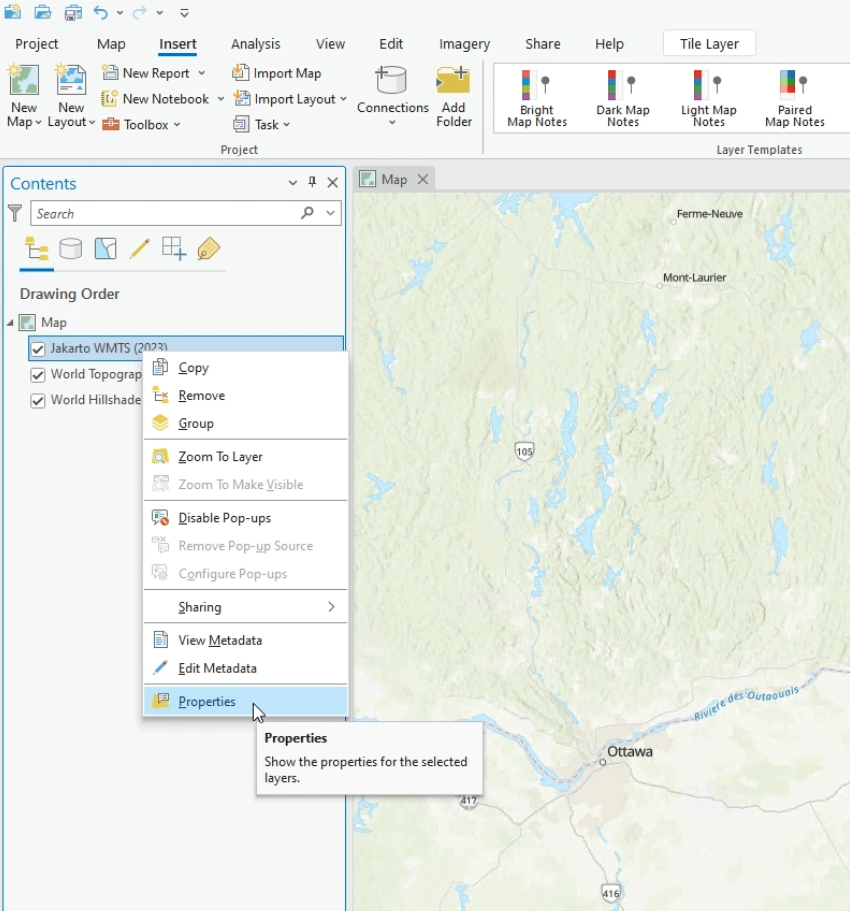
5. Une fois la couche ajoutée à votre carte, cliquez droit sur la couche pour accéder à ses propriétés:

<figure><img src="/files/m8nw2CkaRDZGyBt4nwVY" alt=""><figcaption><p>Afficher les propriétés de la couche</p></figcaption></figure>

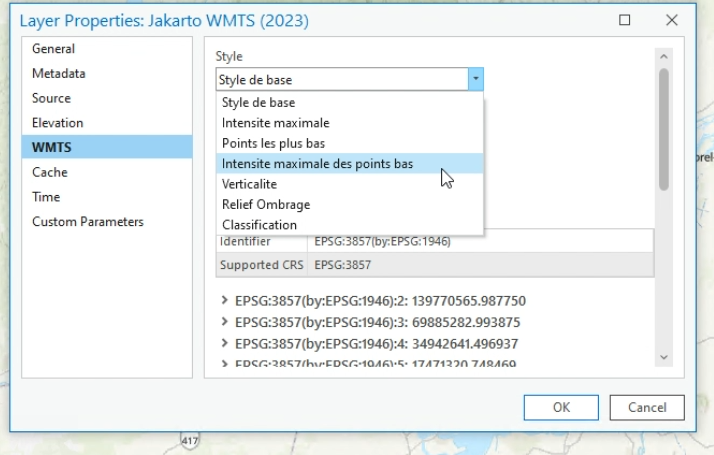
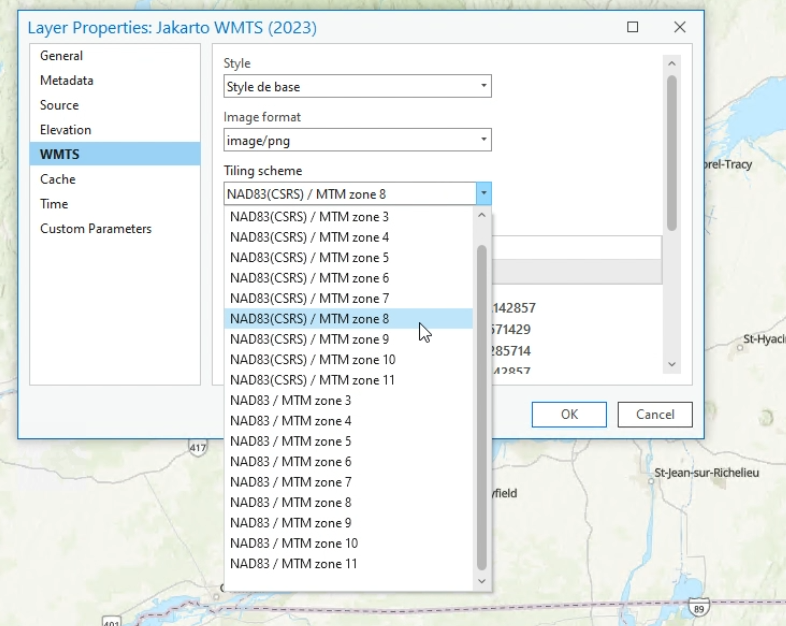
6. Vous pouvez régler le style de la couche et le système de projection de la matrice

* Sélectionnez le style parmi les styles proposés

<figure><img src="/files/O8zJbQ3XKr2A9XRnAwPq" alt=""><figcaption><p>Choix du style</p></figcaption></figure>

\* Sélectionnez le système de coordonnées des tuiles qui seront affichées

<figure><img src="/files/ZEBwItDz3qdzG2ReS37Y" alt=""><figcaption><p>Choix de la projection</p></figcaption></figure>

6. Vous avez maintenant les tuiles matricielles de Tiles dans votre SIG

<figure><img src="/files/PQQrLCafKrT3URWadII3" alt=""><figcaption><p>Tuiles matricielles dans votre SIG Arcgis Pro</p></figcaption></figure>


---

# Agent Instructions
This documentation is published with GitBook. GitBook is the documentation platform designed so that both humans and AI agents can read, navigate, and reason over technical content effectively. Learn more at gitbook.com.

## Querying This Documentation
If you need additional information that is not directly available in this page, you can query the documentation dynamically by asking a question.

Perform an HTTP GET request on the current page URL with the `ask` query parameter, and the optional `goal` query parameter:

```
GET https://docs.jakarto.com/guide-tiles/fr/integrer-tiles-dans-arcgis-pro.md?ask=<question>&goal=<endgoal>
```

`ask` is the immediate question: it should be specific, self-contained, and written in natural language.
`goal` is optional and describes the broader end goal you are ultimately trying to accomplish on behalf of the user. GitBook uses it to tailor the answer towards what is most useful for that goal.

The response will contain a direct answer to the question and relevant excerpts and sources from the documentation.

Use this mechanism when the answer is not explicitly present in the current page, you need clarification or additional context, or you want to retrieve related documentation sections.